Perovskites are materials that share a crystal structure similar to the mineral called perovskite, which consists of calcium titanium oxide (CaTiO3).

Depending on which atoms/molecules are used in the structure, perovskites can possess an impressive array of interesting properties including superconductivity, ferroelectricity, charge ordering, spin dependent transport and much more. Perovskites therefore hold exciting opportunities for physicists, chemists and material scientists.
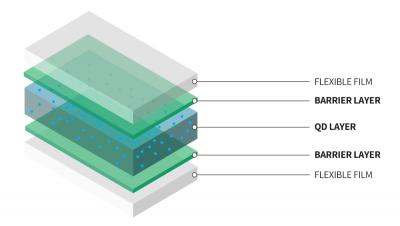
Quantum dots (QDs), sometimes referred to as semiconducting nanocrystals (NCs), are miniscule particles of a semiconducting material with diameters in the range of 2-10 nanometers (roughly 1,000-10,000 atoms). Quantum dots have properties labeled as intermediate between bulk semiconductors and discrete atoms or molecules. Their optoelectronic properties change as a function of both size and shape. QDs demonstrate optical and electronic properties different from those of larger particles. In fact, QDs tend to exhibit quantum size effects in their optical and electronic properties, like tunable and efficient photoluminescence (PL), with narrow emission and photochemical stability. This is why QDs have been incorporated as active elements in a wide variety of devices and applications, some of which are already commercially available, such as QD-based displays.
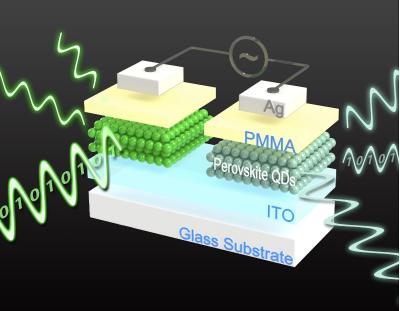
Perovskite quantum dots (PQDs) are a class of quantum dots based on perovskite materials. While these are relatively new, they have already been shown to have properties matching or surpassing those of the metal chalcogenide QDs: they are more tolerant to defects and have excellent photoluminescence quantum yields and high colour purity. Such attractive properties are extremely suited for electronic and optoelectronic applications and so perovskite quantum dots have significant potential for real world applications, some of which are already emerging, including LED displays and quantum dot solar cells.