What are perovskite?
Perovskites are a class of materials that share a similar structure, which display a myriad of exciting properties like superconductivity, magnetoresistance and more. These easily synthesized materials are considered the future of solar cells, as their distinctive structure makes them perfect for enabling low-cost, efficient photovoltaics. They are also predicted to play a role in next-gen electric vehicle batteries, sensors, lasers and much more.
How does the PV market look today?
In general, Photovoltaic (PV) technologies can be viewed as divided into two main categories: wafer-based PV (also called 1st generation PVs) and thin-film cell PVs. Traditional crystalline silicon (c-Si) cells (both single crystalline silicon and multi-crystalline silicon) and gallium arsenide (GaAs) cells belong to the wafer-based PVs, with c-Si cells dominating the current PV market (about 90% market share) and GaAs exhibiting the highest efficiency.
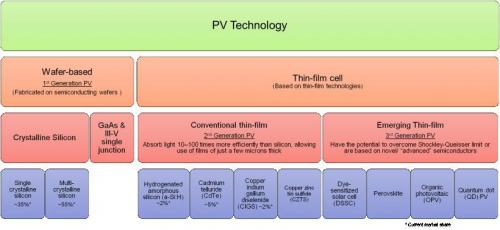
Thin-film cells normally absorb light more efficiently than silicon, allowing the use of extremely thin films. Cadmium telluride (CdTe) technology has been successfully commercialized, with more than 20% cell efficiency and 17.5% module efficiency record and such cells currently hold about 5% of the total market. Other commercial thin-film technologies include hydrogenated amorphous silicon (a-Si:H) and copper indium gallium (di)selenide (CIGS) cells, taking approximately 2% market share each today. Copper zinc tin sulphide technology has been under R&D for years and will probably require some time until actual commercialization.
What is a perovskite solar cell?
An emerging thin-film PV class is being formed, also called 3rd generation PVs, which refers to PVs using technologies that have the potential to overcome current efficiency and performance limits or are based on novel materials. This 3rd generation of PVs includes DSSC, organic photovoltaic (OPV), quantum dot (QD) PV and perovskite PV.
A perovskite solar cell is a type of solar cell which includes a perovskite structured compound, most commonly a hybrid organic-inorganic lead or tin halide-based material, as the light-harvesting active layer. Perovskite materials such as methylammonium lead halides are cheap to produce and relatively simple to manufacture. Perovskites possess intrinsic properties like broad absorption spectrum, fast charge separation, long transport distance of electrons and holes, long carrier separation lifetime, and more, that make them very promising materials for solid-state solar cells.
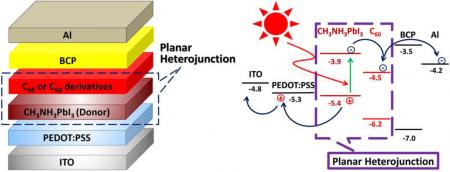
Perovskite solar cells are, without a doubt, the rising star in the field of photovoltaics. They are causing excitement within the solar power industry with their ability to absorb light across almost all visible wavelengths, exceptional power conversion efficiencies already exceeding 20% in the lab, and relative ease of fabrication. Perovskite solar cells still face several challenge, but much work is put into facing them and some companies, are already talking about commercializing them in the near future.
What are the advantages of Perovskite solar cells?
Put simply, perovskite solar cells aim to increase the efficiency and lower the cost of solar energy. Perovskite PVs indeed hold promise for high efficiencies, as well as low potential material & reduced processing costs. A big advantage perovskite PVs have over conventional solar technology is that they can react to various different wavelengths of light, which lets them convert more of the sunlight that reaches them into electricity.
Moreover, they offer flexibility, semi-transparency, tailored form factors, light-weight and more. Naturally, electronics designers and researchers are certain that such characteristics will open up many more applications for solar cells.
What is holding perovskite PVs back?
Despite its great potential, perovskite solar cell technology is still in the early stages of commercialization compared with other mature solar technologies as there are a number of concerns remaining.
One problem is their overall cost (for several reasons, mainly since currently the most common electrode material in perovskite solar cells is gold), and another is that cheaper perovskite solar cells have a short lifespan. Perovskite PVs also deteriorate rapidly in the presence of moisture and the decay products attack metal electrodes. Heavy encapsulation to protect perovskite can add to the cell cost and weight. Scaling up is another issue - reported high efficiency ratings have been achieved using small cells, which is great for lab testing, but too small to be used in an actual solar panel.
A major issue is toxicity - a substance called PbI is one of the breakdown products of perovskite. This is known to be toxic and there are concerns that it may be carcinogenic (although this is still an unproven point). Also, many perovskite cells use lead, a massive pollutant. Researchers are constantly seeking substitutions, and have already made working cells using tin instead. (with efficiency at only 6%, but improvements will surely follow).
What’s next?
While major challenges indeed exist, perovskite solar cells are still touted as the PV technology of the future, and much development work and research are put into making this a reality. Scientists and companies are working towards increasing efficiency and stability, prolonging lifetime and replacing toxic materials with safer ones. Researchers are also looking at the benefits of combining perovskites with other technologies, like silicon for example, to create what is referred to as “tandem cells”.
Commercial activity in the field of perovskite PV
In September 2015, Australia-based organic PV and perovskite solar cell (PSC) developer Dyesol declared a major breakthrough in perovskite stability for solar applications. Dyesol claims to have made a significant breakthrough on small perovskite solar cells, with “meaningful numbers” of 10% efficient strip cells exhibiting less than 10% relative degradation when exposed to continuous light soaking for over 1000 hours. Dyesol was also awarded a $0.5 million grant from the Australian Renewable Energy Agency (ARENA) to commercialize an innovative, very high efficiency perovskite solar cell.
Also in 2015, Saule Technologies signed an investment deal with Hideo Sawada, a Japanese investment company. Saule aims to combine perovskite solar cells with other currently available products, and this investment agreement came only a year after the company was launched.
In October 2020, Saule launched sunbreaker lamellas equipped with perovskite solar cells. The product is planned to soon be marketed across across Europe and potentially go global after that.
In August 2020, reports out of China suggested that a perovskite photovoltaic cell production line has gone into production in Quzhou, east China's Zhejiang Province. The 40-hectare factory was reportedly funded by Microquanta Semiconductor and expected to produce more than 200,000 square meters of photovoltaic glass before the end of 2020.
In September 2020, Oxford PV's Professor Henry Snaith stated that the Company's perovskite-based solar cells are scheduled to go on sale next year, probably by mid 2021. These will be perovskite solar cells integrated with standard silicon solar cells.
The latest perovskite solar news:
Researchers develop method for non-laser, all-vapor-phase processed perovskite solar modules stabilized by naturally formed barrier layers
Researchers at HZB's HySPRINT Innovation Lab, China's Tianjin University of Technology and Tianjin Institute of Power Sources have developed a non-laser additive method for manufacturing perovskite solar modules, in which an adjustable wire mask (AWM) was used to form the channels that were traditionally scribed by lasers.
When module channels are made by conventional laser scribing, the heat-sensitive perovskite materials decompose, and the decomposition of perovskites in the open channel leads to reduced module stability. The electrode corrosion caused by the direct contact between the exposed perovskites and the metal electrode significantly increases the series resistance of the module. In this recent work, the team developed a non-laser additive method for manufacturing perovskite solar modules, in which an adjustable wire mask (AWM) was used to form the channels that were traditionally scribed by lasers. This method for making modules prevents contact between perovskites and electrodes. All layers, including perovskites, hole/electron transporting, and passivating and electrode layers, were fabricated via vapor-phase deposition, and by tuning the precursor composition, a power conversion efficiency (PCE) of 21.7% was obtained (0.1 cm2).
Wuxi UtmoLight reports 20.7% steady-state efficiency for its perovskite solar modules
Chinese perovskite PV manufacturer Wuxi UtmoLight has announced ‘a new world record’ for steady-state efficiency on large-size perovskite solar modules. It has achieved 20.7% efficiency on an 810 cm² module. The Company claims to have attained a certification to this efficiency level by China’s National Photovoltaic Industry Measurement and Testing Center.
UtmoLight says it significantly improved the crystallization of perovskite films by regulating the stress of the perovskite bulk phase and interface during the process of film formation, without sharing other details. The Chinese company has been making efforts to establish industrial production of perovskite modules. Currently operating a 150 MW line in China, it aims to expand to a GW-scale perovskite PV production line.
Researchers use crown ethers to simultaneously prevent lead leakage and moisture degradation
Researchers at Korea's Pusan National University, Kyungpook National University, Switzerland's École Polytechnique Fédérale de Lausanne (EPFL) and University of Fribourg have pioneered an approach that not only rectifies lead leakage but also focuses on interfacial passivation. The team used the method to achieve perovskite solar cells with 21.7% power conversion energy.
The presence of lead ions in perovskite solar cells not only causes lead leakage, which is hazardous to the environment, but in the presence of moisture, the perovskite tends to degrade. Multiple approaches have been suggested to resolve this issue, including encapsulating the device and compositional engineering of the perovskite light absorbers. The crown ether was found to assist in resisting degradation due to moisture for 300 hours at room temperature and 85 percent humidity. In the study, the researchers tested many crown ethers, but found that B18C6 was the best for interfacial passivation.
Researchers reveal ways to tune surface properties of perovskites
Researchers from MIT, University of Cambridge, University of Washington and Korea Research Institute of Chemical Technology have reported a set of recommendations for how to tune surface properties of perovskites - ways to optimize efficiency and better control degradation, by engineering the nanoscale structure of perovskite devices - towards the commercialization of perovskite-based solar cells.
The recent work addresses the two main hurdles that have been plaguing perovskite solar cells: their longevity and the challenge of maintaining high efficiency across larger module areas.
Researchers determine if commercial scale production of perovskite is feasible from a material supply perspective
Researchers from Germany's Philipps-University Marburg, Fraunhofer Institute for Solar Energy Systems ISE, Fraunhofer Research Institution for Materials Recycling and Resource Strategies IWKS, Potsdam Institute for Climate Impact Research and Sweden's Uppsala University have examined the question of availability of enough materials to produce perovskite PVs on the multi-terawatt-scale needed to make a significant contribution to climate change mitigation.
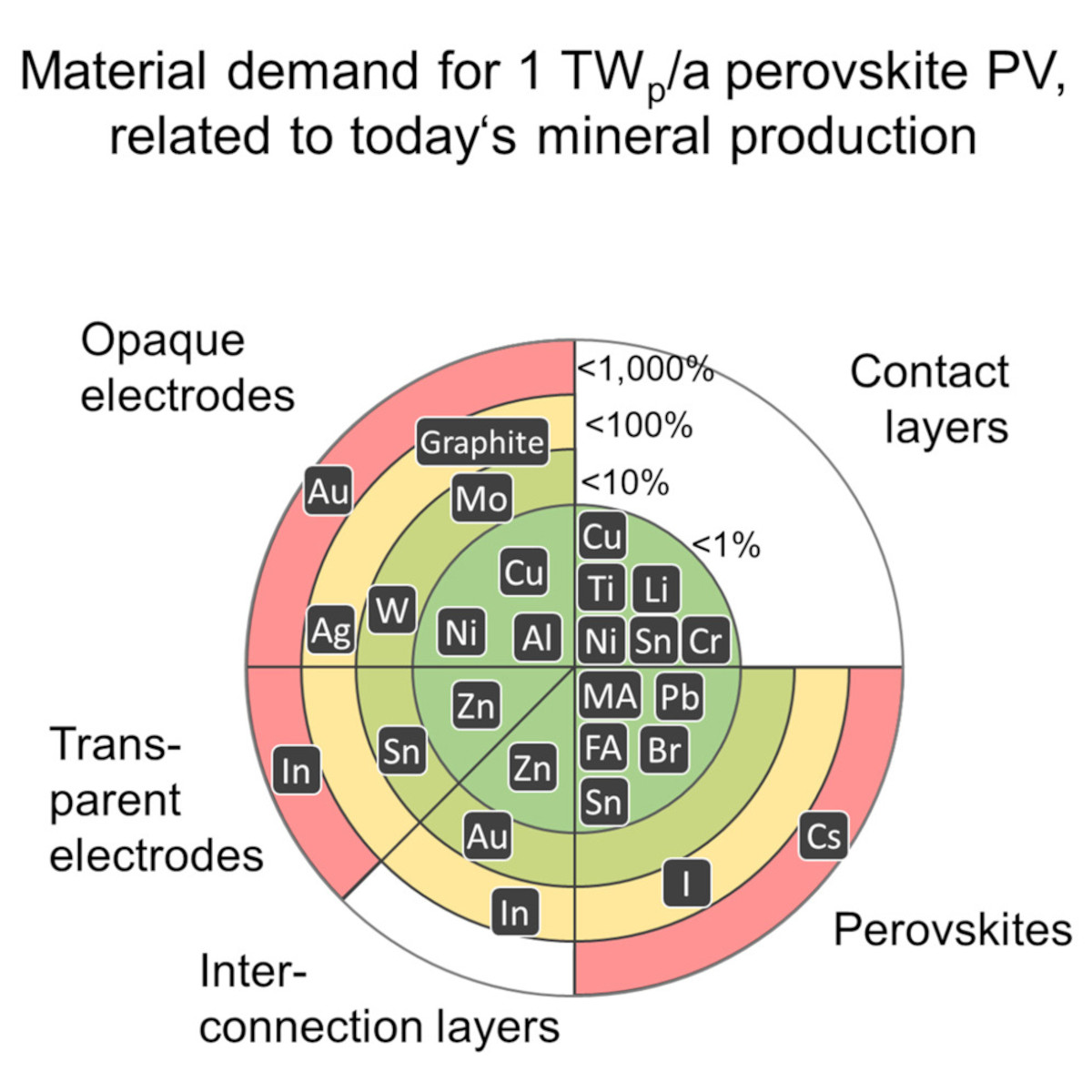
The scientists assessed the material demand for a multi-TW-scale perovskite PV production, identified potential supply risks for each material, and derived guidelines for further device optimization and material research. The study is based on a model for future multi-TW perovskite PV production that is coupled to an inventory of the most relevant materials used for PSC production. The team considered two factors of supply criticality, namely, mining capacity for minerals and the production capacity for synthetic materials.
Researchers achieve 24.5% conversion efficiency of large area all perovskite tandem solar cells
Researchers from Nanjing University, University of Victoria and Australian National University have achieved a high conversion efficiency of 24.5% on large-size all-perovskite tandem solar cells. The result, which the team states is a new world record for the efficiency of all-perovskite tandem solar cells, has reporetdly been confirmed by an international third-party testing institute.
When a lead-tin perovskite is used instead of silicon as the narrow band gap cell in all-perovskite tandem solar cells, the result is often low film quality and device efficiency due to nonuniform nucleation and fast crystallization. In this recent work, the team shows that aminoacetamide hydrochloride can strongly coordinate the precursor components in solution, which homogenizes the crystallization process and also passivates the buried perovskite interface. The authors achieved a certified power conversion efficiency of 24.5% for a 20-square-centimeter module made by blade-coating the layers.
Solaires and Genesis Tech announce JV for high efficiency perovskite PV modules
Solaires Entreprises, a cleantech startup that develops high power conversion efficiency photovoltaic modules, has announced a Joint Venture with Genesis Technologies, a Shanghai based manufacturer. The companies will be working towards mass production of PV modules to replace batteries in indoor electronic devices, as the JV's first phase.
Solaires will provide the technology and Genesis will provide manufacturing as part of the Joint Venture. Genesis Technologies has committed to investing more than $4 Million USD to develop Solaires’ manufacturing site through purchasing production line equipment, carrying out personnel training and executing daily operations for the Joint Venture.
Researchers design efficient flexible perovskite solar cell using scalable methods in ambient conditions
Researchers at the University of Victoria in Canada and Solaires Enterprises have designed a flexible perovskite solar cell with an active area of 0.049 cm2 based on a polyethylene terephthalate (PET) substrate and a reactant known as phenyltrimethylammonium chloride (PTACl) in ambient air fabrication. Tested under standard illumination conditions, the flexible perovskite device achieved a power conversion efficiency of 17.6%, an open-circuit voltage of 0.95 V, a short-circuit current density of 23 mA cm−2, and a fill factor of 80%.
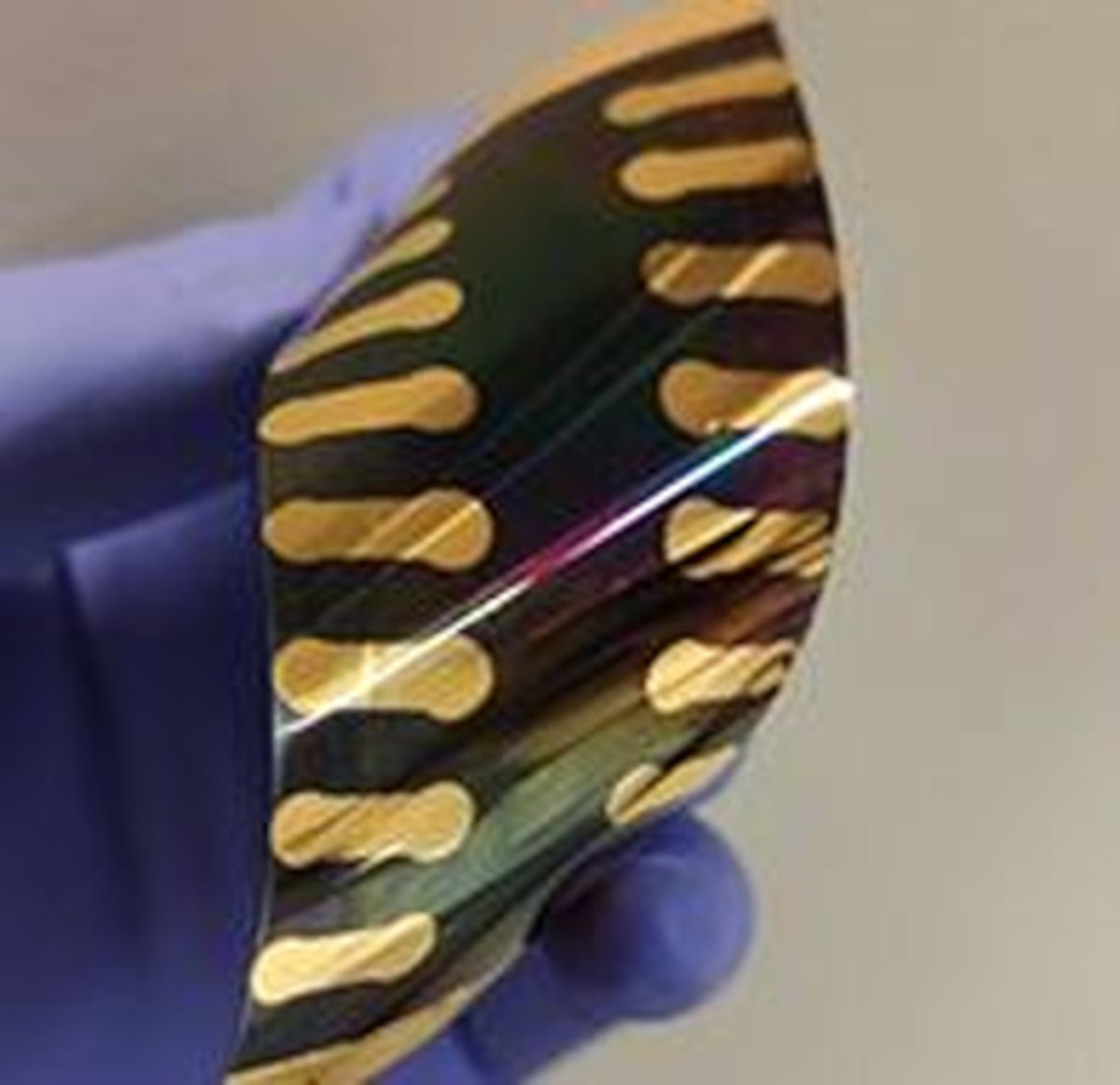
The team explained that PET is cheaper than commonly utilized polyethylene naphthalate (PEN) in substrates for flexible solar cells, with the latter having however the advantage of being more thermally stable during the production process. PET, by contrast, has a maximum temperature tolerance of 100 C and can tolerate deposition procedures under this threshold. For this reason, the research group chose a cell architecture with a substrate made of PET and indium tin oxide (ITO), an electron transport layer (ETL) based on tin oxide (SnO2), a methylammonium lead iodide (MAPbI3) perovskite absorber, a Spiro-OMeTAD hole-transporting layer (HTL), and a gold (Au) metal contact.
Researchers develop inverted perovskite solar cell with 2D/3D heterojunctions that achieves 25.6% efficiency
An international team of researchers from King Abdullah University of Science and Technology (KAUST), Ulsan National Institute of Science and Technology (UNIST) and the Chinese Academy of Sciences have reportedly developed an inverted perovskite solar cell incorporating low-dimensional perovskite layers at the solar cell's top and bottom interfaces.
The team achieved optimal passivation in inverted perovskite solar cells by applying thin layers of low-dimensional perovskite on top of a 3D perovskite film. The resulting cell achieved an open-circuit voltage of 1.19 V, a short-circuit current density of 24.94 mA cm2, and a fill factor of 85.9%.
Researchers develop semi-transparent perovskite solar cells with 21.68% efficiency
Researchers from the Korea Institute of Energy Research (KIER), Korea Research Institute of Standards and Science, Jusung Engineering and the Jülich Research Center have reported an advancement in the stability and efficiency of semi-transparent perovskite solar cells.
The semi-transparent solar cells achieved an impressive efficiency of 21.68%, which is said to be the highest efficiency to date among perovskite solar cells that use transparent electrodes. Additionally, they showed remarkable durability, with over 99% of their initial efficiency maintained after 240 hours of operation.